
Indirect Representation
in the EU
Import into the EU with a dedicated indirect customs representative by your side.
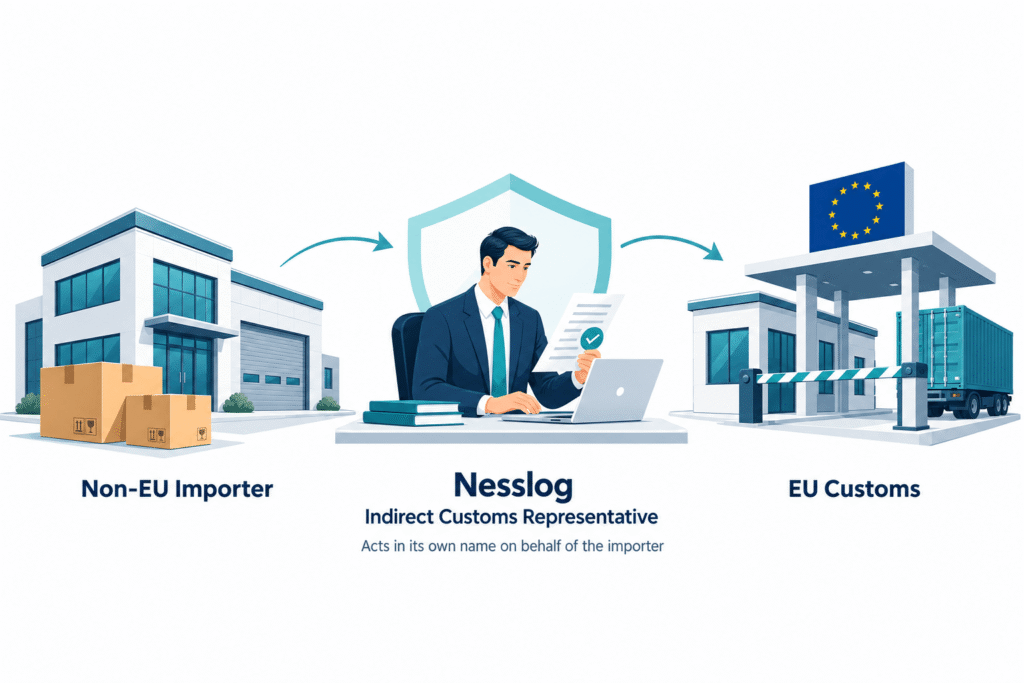
If your company is established outside the European Union, importing goods into the EU can raise questions about who can act as importer, customs representation, EORI registration, VAT, duties and responsibility for the goods.
Below are some of the most common questions non-EU businesses should consider before their first shipment.
Importing Goods into the EU as a Non-EU Company: FAQs
Can I import goods into the EU if my company is not established in the EU?
Yes, but you need to establish the correct customs structure before importing.
One important consideration is that the Union Customs Code generally requires the declarant to be established in the customs territory of the Union, subject to certain exceptions.
This is one reason why indirect representation can be important for businesses established outside the EU.
Union Customs Code – Regulation (EU) No 952/2013:
https://eur-lex.europa.eu/eli/reg/2013/952/oj/eng
What is Indirect Representation (IR)?
Indirect Representation (IR) is a form of customs representation in which a customs agent lodges a declaration in their own name but on behalf of the seller/importer.
IR in the EU is required when the importer does not have a business residence in an EU member state. An EORI number is not sufficient to customs clear in the EU; it is necessary to have a business residence in the EU.
In this arrangement, the customs agent becomes the declarant, responsible for the content of the declaration and liable for all duties and taxes to be paid.
Customs will usually audit the Indirect Representative within 3 years after the declaration is lodged. The Indirect Representative must keep all documents on file that are necessary to verify the HS code, customs evaluation, and other requirements relevant to the import process. Examples include purchase orders, purchasing or sales contracts, product data sheets, proof of payments, warehousing and shipping records.
Can Nesslog act as my indirect representative if my company is outside the EU?
Yes, subject to onboarding, the country of import, the type of goods and acceptance of the proposed import structure.
Because an indirect representative assumes customs liability, we first need to understand your company, products and supply chain.
Before accepting representation, we may therefore request company documents, EORI and VAT information, product information, commodity codes, customs values, origin information, Incoterms and other supporting documents.
Do I need an EORI number if I use an indirect representative?
Depending on your role and customs activities, your non-EU business may or may not require an EORI.
An EORI identifies economic operators and other relevant persons in their dealings with EU customs authorities.
See the European Commission’s EORI guidance:
https://taxation-customs.ec.europa.eu/customs/customs-procedures-import-and-export/customs-operations/economic-operators-registration-and-identification-number-eori_en
EORI requirements should be checked before the first customs operation.
Is my EORI number valid throughout the EU?
Yes, an EORI number is valid throughout the EU and can be used in all EU Member States.
Do I need an EU VAT number to use indirect representation?
A company without an EU establishment that uses indirect customs representation should have a VAT identification number, ideally in the Member State where it imports goods, to facilitate the recovery of import VAT from the relevant tax authorities.
Having a VAT identification number in one Member State may allow a company to recover VAT paid in other Member States, subject to the applicable rules. However, this process can be complex and may require specialist tax expertise.
It is therefore important to verify whether the importer can use its existing VAT registration or needs separate VAT registrations in the Member States where it carries out import customs clearance.
Who pays the customs duties?
Commercially, the parties need to determine who bears the cost.
From a customs-liability perspective, indirect representation is particularly important because the indirect representative is the declarant and the represented person can also be a debtor for the relevant customs debt.
See Article 77 of the Union Customs Code:
https://eur-lex.europa.eu/eli/reg/2013/952/oj/eng
This is why the indirect representative needs reliable classification, valuation, origin and transaction information.
Can I send the goods first and arrange indirect representation when they arrive?
This is strongly discouraged.
The customs structure should be established before the goods leave the country of export.
Otherwise, the shipment could arrive without an accepted customs representative, correct EORI arrangement, VAT solution, necessary licenses or other required documentation.
This can lead to delays, storage charges and potentially the need to reroute or return the goods.
If my goods clear customs in one EU country, can they move freely to another?
Once non-Union goods have been properly released for free circulation, they generally acquire Union status and can circulate within the EU customs territory, subject to other applicable requirements.
However, movement between Member States can still have VAT, excise, product-control or reporting implications.
“Customs cleared” therefore does not necessarily mean “no further obligations.”
Can I use the same indirect representative for every EU country?
Not automatically.
EU customs legislation provides a common legal framework, but customs declarations are processed through Member State customs administrations and national systems.
Operational requirements can differ between countries.
Nesslog works with a network of trusted customs partners across EU Member States, allowing us to help coordinate customs solutions where a customer’s supply chain involves multiple European countries.
How long does it take to set up indirect representation?
There is no universal timeframe.
It depends on factors such as:
- whether you already have the necessary EORI;
- VAT arrangements;
- completeness of company documentation;
- products being imported;
- customs classification;
- origin;
- country of import;
- licenses or certificates required; and
- the complexity of the proposed supply chain.
For this reason, businesses should contact their customs representative before booking or dispatching the first shipment.
https://taxation-customs.ec.europa.eu/taxation/vat/vat-directive_en
https://europa.eu/youreurope/business/finance-and-tax/vat/vat-rules-rates/index_en.htmVAT rules and rates: standard, special & reduced rates – Your Europe